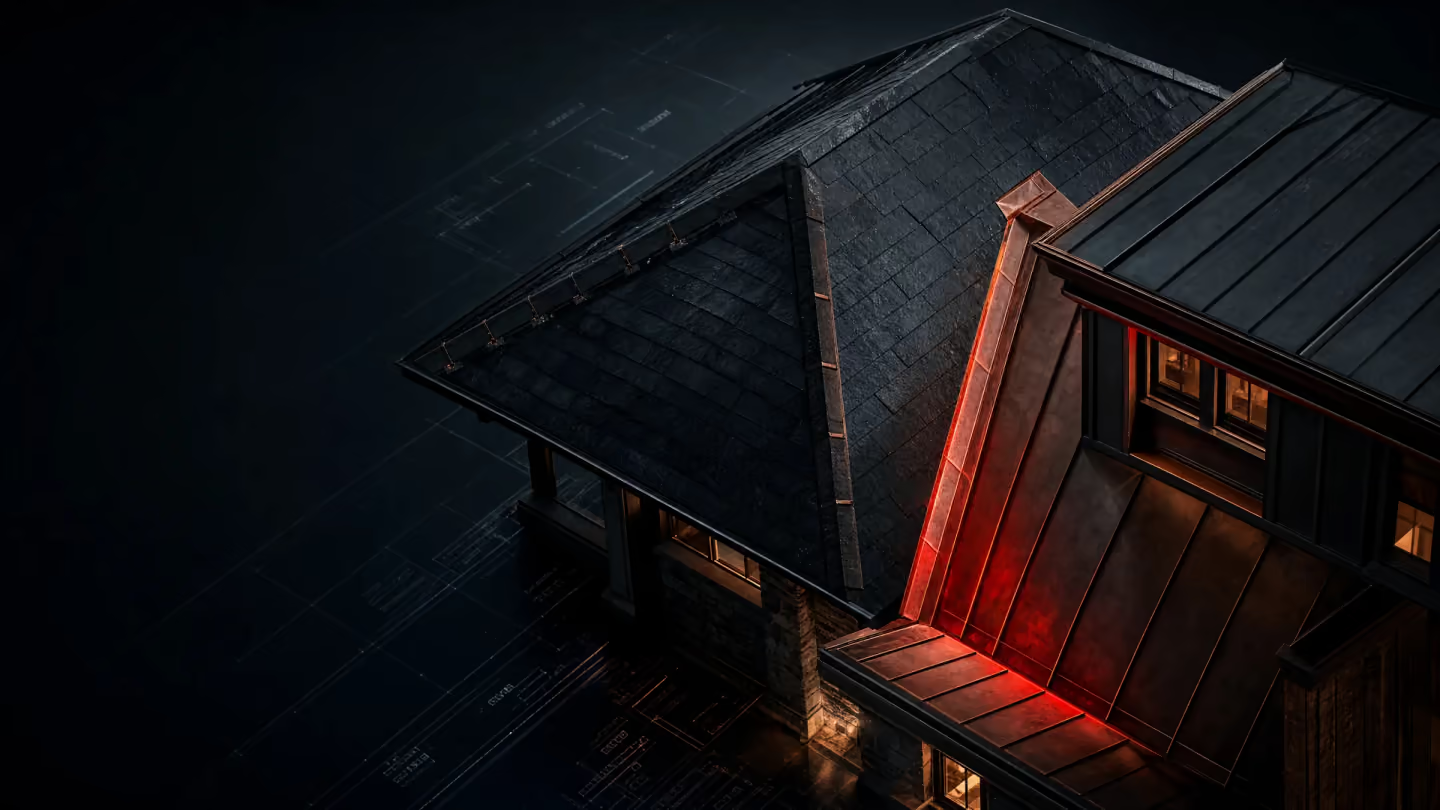
Close architectural view of slate, copper, and standing-seam specialty roofing at dusk

Specialty Roofing Systems

Your source for specialty roofing materials — from the modern look of metal to the timeless elegance of slate and clay.

Clay and concrete tile, natural and synthetic slate, metal slate, and copper — matched to what your structure can carry and how long you plan to own it.

  • Veteran-owned
  • Five-state service
  • Free inspection

Specialty Roofing Systems, clearly scoped.

Specialty roofing covers everything past asphalt: clay tile, concrete tile, real slate, imitation and synthetic slate, metal slate, copper slate, and copper specialties. These are roofs that change the character of a building, and they involve tradeoffs that asphalt does not — weight, service life, cost of skilled installation, and how the material behaves under hail.

01SCOPE MODULE

Start with dead load

The first question on any tile or slate roof is whether the structure can carry it, and it is a question for a structural engineer, not a salesperson. Asphalt shingles run roughly two to four pounds per square foot. Clay tile lands around six to ten. Concrete tile is heavier still, commonly nine to twelve. Natural slate varies enormously with thickness and quarry, from about eight pounds per square foot to well over fifteen for heavy graduated slate.

A house framed for shingles may need reinforced rafters, added purlins, or a redesigned framing plan before it can accept tile. That is why a lightweight composite is often the honest answer on a retrofit: it delivers the profile without the structural work.

02SCOPE MODULE

Service life by material

  • Asphalt shingles — roughly twenty to thirty years, less under intense sun and repeated hail.
  • Metal — commonly forty to seventy years for a properly detailed standing-seam system, with the coating and the fasteners usually aging before the panel does.
  • Concrete and clay tile — fifty years and often much longer. In practice the tile outlives the underlayment beneath it, which is the point most owners miss.
  • Natural slate — the longest-lived roofing material in common use, with hard slates measured in generations rather than decades. The fasteners and flashings, not the stone, typically set the replacement date.
  • Synthetic and composite slate — engineered products carrying long manufacturer warranties, with impact and fire ratings that natural slate does not offer.
03SCOPE MODULE

Under tile, the underlayment is the roof

This is the most important thing to understand about a tile roof. Tile sheds the bulk of the water and shields what is beneath it from UV, but tile is not a watertight surface — wind-driven rain gets past it. The membrane on the deck is the actual waterproofing layer, and it is the component that ages out first.

That produces a maintenance event most owners are never told about: the relay. Somewhere in a tile roof’s life the tile gets carefully removed and stacked, the underlayment is replaced, and the same tile is reset. Deck temperatures under tile and metal run far hotter than under shingles, which is why high-temperature synthetic underlayment such as Sharkskin is specified there — standard felt cooks and fails early in that environment.

04SCOPE MODULE

Why synthetic composites exist

Natural slate is heavy, brittle underfoot, expensive to install, and requires a trained slater whose skills are increasingly rare. Composite slate and shake were engineered around every one of those constraints: a fraction of the weight, consistent thickness and shape, installation with standard roofing tools, and blended color ranges that read as natural variation from the ground.

In hail country the impact rating is the deciding factor for many owners. Class 4 is the top rating under the UL 2218 impact standard — a steel ball dropped on the product from a set height, twice on the same spot, with no cracking or rupture permitted — and many carriers offer a premium credit for a Class 4 roof. CMAC installs composite slate and shake from DaVinci Roofscapes, Brava Tile, and Inspire Roofing Products.

05SCOPE MODULE

Metal, standing seam, and batten seam

Metal roofing splits into exposed-fastener panels, where screws with neoprene washers go through the face of the panel, and concealed-fastener standing seam, where clips hold the panel and the fasteners never penetrate the weather surface. Standing seam costs more and lasts longer, largely because the clips let the panel expand and contract with temperature instead of working against a fixed screw. Snap-lock seams suit steeper slopes; mechanically seamed double-lock panels are what you use as slope decreases.

Batten seam is the traditional alternative: the panel edges turn up against a wood batten and a separate cap covers it, producing a heavier, more architectural shadow line. It is the classic copper detail on historic and high-end residential work. On any metal roof, some degree of oil-canning — visible waviness in the flat of the panel — is inherent to flat sheet metal, and it is managed with striations, heavier gauge, and a flat substrate rather than eliminated.

06SCOPE MODULE

Copper

Copper is chosen for how it ages. It starts bright, darkens to russet and then chocolate brown over the first years, and eventually develops the green patina people associate with it — a process that takes decades and runs faster in humid, coastal, and industrial air than in dry inland climates. Two practical notes: copper runoff will stain masonry, stone, and concrete beneath it, so terminations get planned; and copper must never be fastened with steel or paired downstream of galvanized metal, because the galvanic reaction destroys the lesser metal.

Copper slate and metal slate are individual pressed shingles with a slate-like profile that interlock on all four sides, available in copper, steel, and aluminum. They give the geometry of a slate roof at a metal roof’s weight, and copper versions patina like any other copper roof.

07SCOPE MODULE

The lines CMAC installs

Concrete tile from West Lake, Eagle Roofing Products, and Crown Roof Tile. Clay tile from Ludowici, MCA Clay Roof Tile, Verea Clay Tile, and Crown Roof Tile. Natural quarried slate including Vermont Slate. Composite slate, shake, and tile from Brava Tile, DaVinci Roofscapes, and Inspire Roofing Products. High-temperature synthetic underlayment from Sharkskin beneath tile and metal systems.

What specialty roofing systems includes

Clay and concrete tile

Barrel, S-tile, and flat profiles in clay and concrete, over a properly specified high-temperature underlayment.

Natural slate

Quarried slate installed as a fastened stone roof, with the flashings detailed to match its service life.

Synthetic and composite slate

The slate and shake profile at a fraction of the weight, with Class 4 impact ratings available.

Metal and metal slate

Standing seam, batten seam, exposed-fastener panels, and interlocking pressed metal slate shingles.

Copper specialties

Copper roofs, bay and dormer roofs, chimney caps, finials, and custom sheet metal that patinas as one assembly.

Structural evaluation first

Weight is confirmed against the framing before a tile or slate roof is specified for an existing building.

The CMAC process for specialty roofing systems

  1. 1

    Schedule

    Tell us what is happening at your property.

  2. 2

    Inspect

    We document the property and affected systems carefully.

  3. 3

    Plan

    Review a clear scope and written proposal.

  4. 4

    Build

    The CMAC team completes the approved work.

  5. 5

    Confirm

    A final walkthrough closes out the project.

Systems and manufacturers

  • West LakeConcrete tile
  • Eagle Roofing ProductsConcrete tile
  • Crown Roof TileConcrete and clay tile
  • LudowiciArchitectural clay tile
  • MCA Clay Roof TileClay tile
  • Vermont SlateNatural quarried slate
  • Verea Clay TileSpanish clay tile
  • Brava TileComposite slate, shake, and tile
  • DaVinci RoofscapesSynthetic slate and shake
  • Inspire Roofing ProductsComposite slate
  • SharkskinHigh-temperature synthetic underlayment

Specialty Roofing Systems questions

What does GAF Master Elite® mean?

GAF awards Master Elite® status to a small fraction of roofing contractors in North America. It requires proof of proper licensing, adequate insurance, and a sustained record of quality installations and customer satisfaction. Practically, it means CMAC can offer enhanced GAF system warranties that non-certified contractors cannot, and that GAF has independently vetted the company. CMAC is also a GAF President’s Club award winner.

Do you charge for an inspection or an estimate?

No. The inspection, the damage documentation including drone photography, and the written estimate are all free and carry no obligation. If the roof does not need work, we will tell you that.

Will CMAC work with my insurance company?

CMAC can document visible damage, provide a contractor report, and attend the carrier’s inspection to explain the proposed repair scope. CMAC is a contractor, not a public adjuster or law firm, and does not interpret policy coverage or represent a policyholder in a coverage dispute.

How do I know whether to repair or replace my roof?

Age relative to the material’s service life, how widespread the damage is, and whether you have had more than one leak are the deciding factors. Isolated damage on a roof with years of life left is a repair. Widespread granule loss, exposed mat, multiple leak points, or hail bruising across every slope generally means replacement, because patching a failing system just moves the next leak somewhere else. An inspection settles it.

How long does a roof replacement take?

Most residential asphalt shingle replacements are a one to two day job once materials are on site. Tile, slate, metal, and complex roof geometry take longer. Weather, decking replacement discovered after tear-off, and permit or HOA requirements are the usual reasons a schedule moves.

My roof looks fine from the ground. Could it still be damaged?

Frequently, yes. Hail bruises the mat underneath the granule surface, and that bruising is often invisible from the ground and sometimes hard to see from a ladder. It shortens the roof’s life and creates the leaks you will discover a year or two later, after your claim window has closed. That is why documented post-storm inspections matter.

Start with a free inspection.

Tell CMAC what is happening at the property. We will inspect the condition and put the recommended scope in writing.