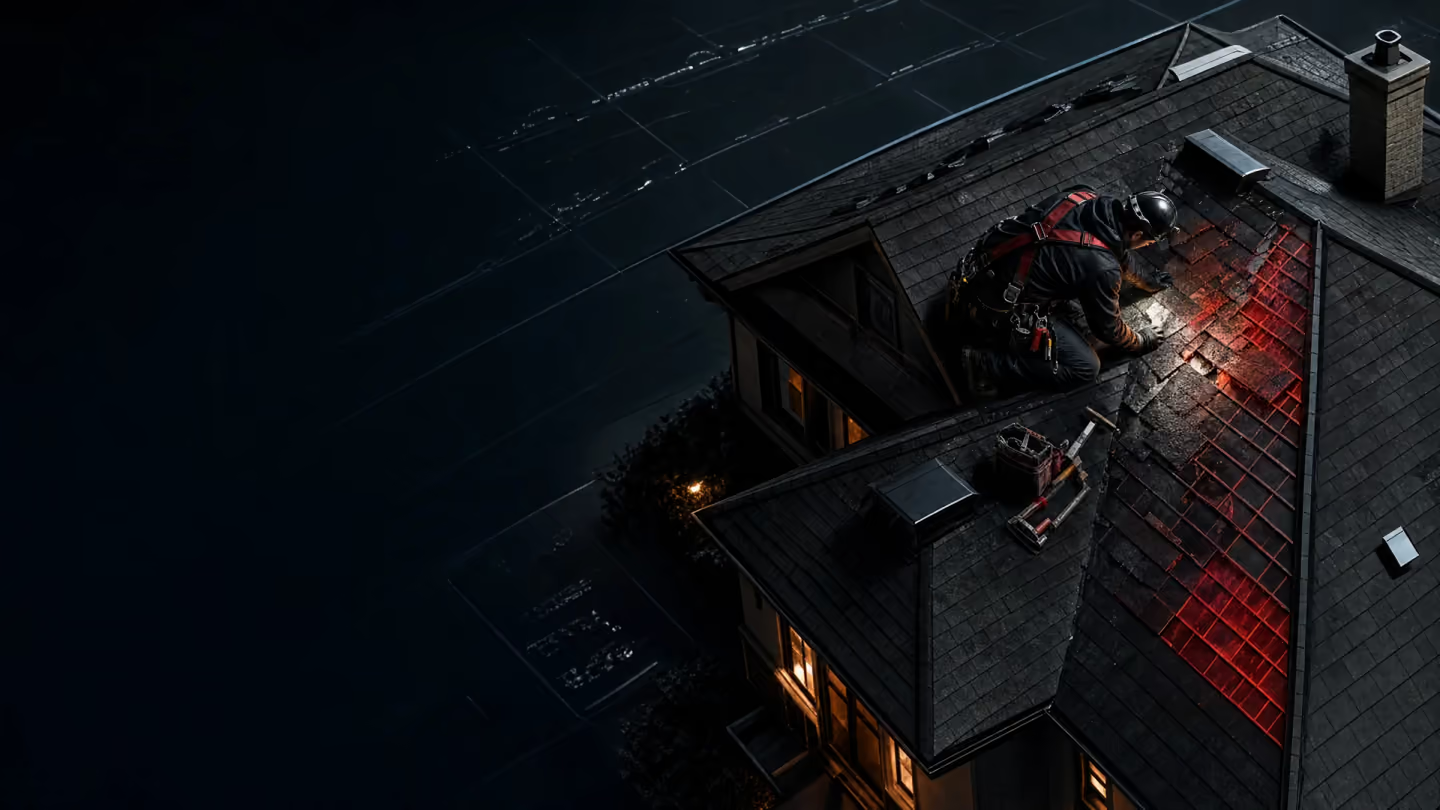
A roofing technician inspecting storm-damaged architectural shingles and flashing at blue hour

Roof Repair

Need reliable roof repair? CMAC handles everything from asphalt to metal roof repair.

Hail damage, roof leaks, and storm damage repaired on asphalt and metal roofs — diagnosed at the source and blended into your existing roof.

  • Veteran-owned
  • Five-state service
  • Free inspection

Roof Repair, clearly scoped.

Need reliable roof repair? At CMAC Roofing, we handle everything from asphalt to metal roof repair — hail damage repair, roof leak repairs, storm damage repair, and blending the repair back into the existing roof so it does not announce itself from the street.

The order matters. A professional inspection finds all of the damage, not just the part you noticed. Then the precise source of the leak gets diagnosed. Then it gets repaired. Then it gets blended. Skipping the first two steps is how a roof gets repaired twice.

01SCOPE MODULE

A leak almost never starts where you see it

Water enters at a penetration or a flashing, runs down the underside of the decking or along a rafter, soaks insulation, and finally shows itself on a ceiling that can be several feet — sometimes a full room — away from the entry point. Wind-driven rain makes it worse: some leaks only appear when rain arrives from one direction, which is why a roof can pass three storms and fail on the fourth.

That is why chasing the stain is the wrong method. The inside of the roof deck, the attic insulation pattern, the rafter staining, and the exterior flashing details together tell you where the water actually got in.

02SCOPE MODULE

The usual failure points

  • Pipe boots. The neoprene collar around a plumbing vent is typically the first thing on a roof to fail. UV splits the rubber at the base of the pipe, often years before the shingles are worn out, and the crack is invisible from the ground.
  • Step flashing. Where a roof plane runs into a wall, every shingle course needs its own piece of flashing woven in with it. A single continuous strip of metal, or a bead of caulk in place of steps, is a leak on a schedule.
  • Valleys. A valley carries the water from two slopes, so it sees the highest volume on the roof. Debris damming, fasteners set too close to the centerline, and worn or undersized valley metal all show up here first.
  • Chimney counterflashing. A chimney needs base flashing on the roof plane and counterflashing let into a mortar joint above it. Counterflashing that was surface-sealed instead of cut in pulls loose as the masonry moves.
  • Ridge. Cap shingles and ridge vents take the most wind exposure on the whole roof, and a lifted cap or a blown-off section of ridge vent lets water in at the highest point, where it can travel the farthest.
  • Nail pops and exposed fasteners. A fastener backing out tents the shingle above it and eventually punctures it. On exposed-fastener metal, the neoprene washers dry out, the screws loosen, and each one becomes a hole.
  • Skylights and curbs. The curb, the head flashing, and the factory seal are three separate things that can fail, and only one of them is fixed by re-sealing the glass.
03SCOPE MODULE

Hail damage is not always visible from the ground

The damage that matters most from hail is bruising: the impact fractures the fiberglass mat underneath the surface while the granules above it may still be sitting in place. A bruise feels soft underfoot, like a bruise on fruit, and it does not read as damage in a photo taken from the driveway. Granule loss then accelerates outward from the fracture, the mat gets exposed to UV, and the shingle fails years early.

Hail is also directional. One or two slopes usually take the storm while the others look untouched, so a roof that looks fine from the front can be finished on the back. Soft metals are the corroborating evidence — dented gutters, downspouts, vent caps, and air conditioner fins date the storm and confirm stone size.

On metal roofing, hail dents panels. Denting alone is often cosmetic, and a dented panel can still shed water for decades. What counts as functional damage on metal is a puncture, a split at a seam, damage that compromises the coating and starts corrosion, or fastener and washer damage that opens the penetration.

04SCOPE MODULE

When a repair genuinely beats a replacement

A repair is the right call when the roof is comfortably inside its material life, the damage is localized to one or two areas rather than spread across the field, the surrounding shingles are still pliable and holding granules, and a reasonable material match is available. Under those conditions a repair buys you the remaining life of the roof for a fraction of the disruption.

A repair is the wrong call when the shingles crack the moment they are lifted, when leaks keep appearing in unrelated places, or when the field is losing granules everywhere. On a brittle roof, the act of walking it and lifting courses to make one repair creates the next two.

05SCOPE MODULE

Blending the repair into the existing roof

Even the same shingle, same manufacturer, and same color code will not match a roof that has been in the Texas sun for a decade — sunlight shifts the granule blend. The trade’s answer is to work with the roof you have: source the closest current match, and where a repair lands on a highly visible elevation, harvest matching weathered shingles from a rear or garage slope and put the new material there instead.

A repair also has to be laced into the existing courses rather than butted against them. A seam that runs straight across a slope is both visible and a water path.

What roof repair includes

Hail damage repair

Slope-by-slope evaluation for bruising, granule loss, and soft-metal collateral damage.

Roof leak repairs

The entry point gets found and fixed, not the ceiling stain underneath it.

Storm damage repair

Wind-lifted shingles, blown ridge caps, torn flashings, and impact punctures after a storm.

Asphalt and metal

Shingle roofs and both standing-seam and exposed-fastener metal systems.

Seamless blending

Material matched and laced into the existing courses so the repair reads as part of the roof.

Free documented inspection

No cost, no obligation, and damage documented with photographs including drone imagery.

How CMAC handles roof repair

  1. 1

    Professional inspection

    The full roof gets inspected — every slope, flashing, penetration, and the ventilation — so all of the damage is found, not just the part you reported.

  2. 2

    Diagnose the source

    The precise entry point of the leak is identified from the roof and the attic side, because water rarely surfaces where it got in.

  3. 3

    Make the repair

    The failed component is replaced along with any decking and underlayment the water reached, rather than sealed over.

  4. 4

    Blend it in

    Material and course layout are matched to the existing roof so the repaired area disappears into the field.

Systems and manufacturers

  • GAFMaster Elite® certified — full shingle system
  • CertainTeedAsphalt shingle systems
  • AtlasAsphalt shingle systems
  • TAMKOAsphalt shingle systems

Roof Repair questions

How do I know whether to repair or replace my roof?

Age relative to the material’s service life, how widespread the damage is, and whether you have had more than one leak are the deciding factors. Isolated damage on a roof with years of life left is a repair. Widespread granule loss, exposed mat, multiple leak points, or hail bruising across every slope generally means replacement, because patching a failing system just moves the next leak somewhere else. An inspection settles it.

My roof looks fine from the ground. Could it still be damaged?

Frequently, yes. Hail bruises the mat underneath the granule surface, and that bruising is often invisible from the ground and sometimes hard to see from a ladder. It shortens the roof’s life and creates the leaks you will discover a year or two later, after your claim window has closed. That is why documented post-storm inspections matter.

What does GAF Master Elite® mean?

GAF awards Master Elite® status to a small fraction of roofing contractors in North America. It requires proof of proper licensing, adequate insurance, and a sustained record of quality installations and customer satisfaction. Practically, it means CMAC can offer enhanced GAF system warranties that non-certified contractors cannot, and that GAF has independently vetted the company. CMAC is also a GAF President’s Club award winner.

Do you charge for an inspection or an estimate?

No. The inspection, the damage documentation including drone photography, and the written estimate are all free and carry no obligation. If the roof does not need work, we will tell you that.

Will CMAC work with my insurance company?

CMAC can document visible damage, provide a contractor report, and attend the carrier’s inspection to explain the proposed repair scope. CMAC is a contractor, not a public adjuster or law firm, and does not interpret policy coverage or represent a policyholder in a coverage dispute.

How long does a roof replacement take?

Most residential asphalt shingle replacements are a one to two day job once materials are on site. Tile, slate, metal, and complex roof geometry take longer. Weather, decking replacement discovered after tear-off, and permit or HOA requirements are the usual reasons a schedule moves.

Start with a free inspection.

Tell CMAC what is happening at the property. We will inspect the condition and put the recommended scope in writing.