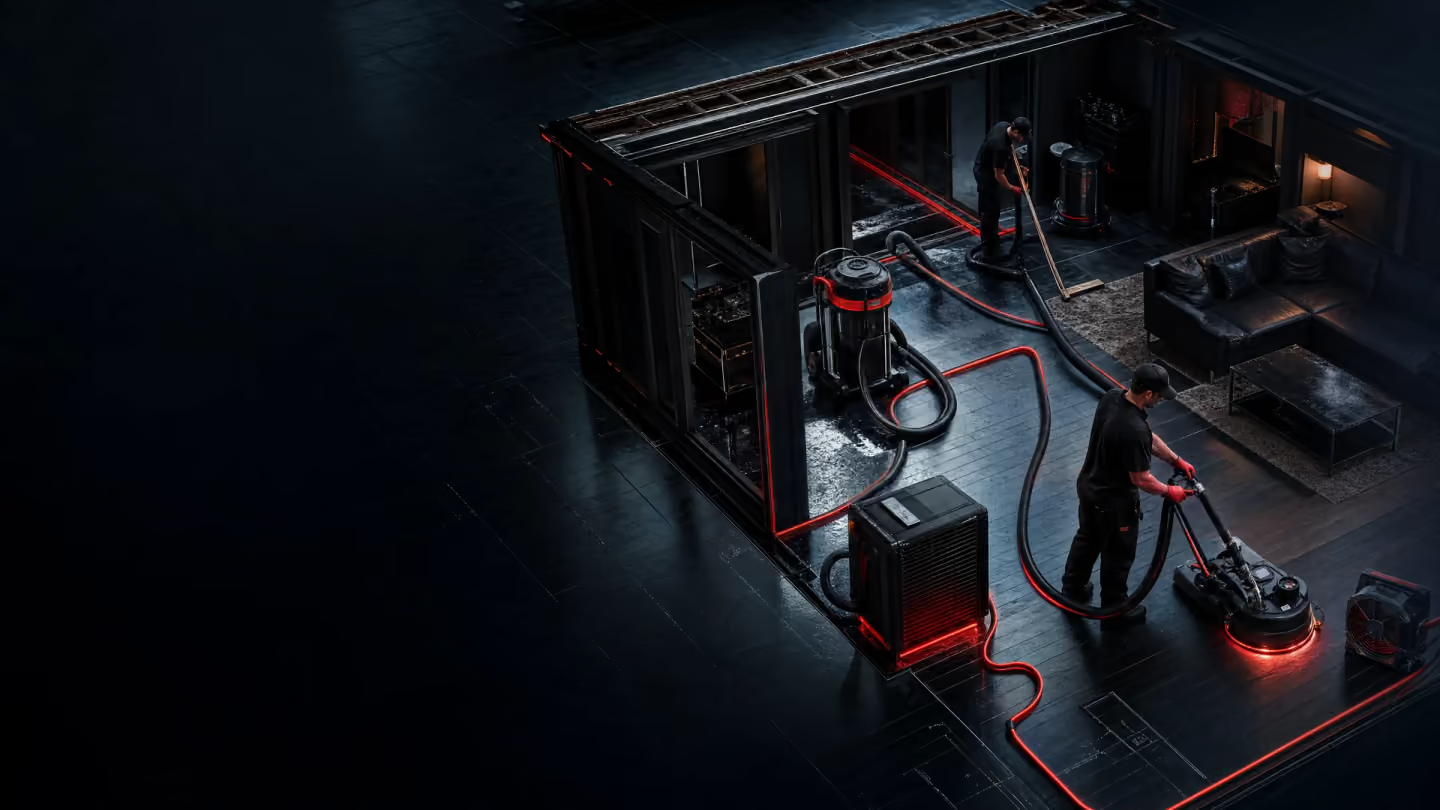
Professional floor extraction and air treatment equipment restoring a refined interior

Floor Care & Odor Control

When cleanliness counts, CMAC delivers

Carpet cleaning and repair, strip and seal, tile and surface cleaning, pet and smoke odor treatment, and dryer and AC vent cleaning.

  • Veteran-owned
  • Five-state service
  • Free inspection

Floor Care & Odor Control, clearly scoped.

Professional floor care and advanced odor control solutions designed to restore cleanliness, eliminate odors at the source, and create healthier indoor environments. Services include carpet cleaning, stain removal treatments, carpet stretching and repairs, strip and seal floor services, tile and surface cleaning, smoke odor removal, pet odor treatment, thermal fogging, and dryer and AC vent cleaning.

01SCOPE MODULE

Odor has a source, and masking is not removal

Air fresheners and scented products add a smell on top of a smell. For a day or two the room seems better, then the covering scent fades and the original odor is exactly where it was. Real odor control removes or chemically destroys the material producing the odor. Anything else is a countdown.

Finding the source is most of the work. Odor is almost always coming from a material that absorbed something — carpet pad, subfloor, drywall, upholstery, duct interiors, or the pan under an appliance — and cleaning everything except that material accomplishes very little.

02SCOPE MODULE

Pet odor goes deeper than the carpet

A visible spot on carpet is the smallest part of the problem. Urine passes through the face fiber and the backing, saturates the pad underneath, and spreads outward — the affected area beneath is usually several times larger than what shows on top. From there it reaches the subfloor, soaks into plywood or the seams and cracks of a concrete slab, and wicks up baseboard and the bottom of the drywall.

This is why surface cleaning fails on pet odor. It also explains the humidity effect: when the air gets damp, remaining salts reactivate and the smell returns in a room that seemed fine all winter. A UV light will reveal the true extent of contamination and is the honest way to scope the work before starting.

Enzymatic treatment is what actually addresses it. Enzymes and beneficial bacteria break down the uric acid crystals and organic material that ordinary detergents leave behind, and they need dwell time to work — applied to the pad and subfloor, not sprayed on the carpet face. Heavy contamination means pad replacement and sealing the subfloor, and there is a point at which the carpet itself has to go. Being told that plainly beats paying repeatedly for cleanings that cannot succeed.

03SCOPE MODULE

Hot water extraction versus low-moisture encapsulation

Hot water extraction — commonly called steam cleaning — injects heated cleaning solution into the carpet under pressure and immediately vacuums it back out along with suspended soil. It is the deepest routine cleaning available and the method most carpet manufacturers specify for warranty maintenance. The trade-off is drying time: airflow matters, and a carpet left wet too long invites the exact odor problem you were trying to solve.

Low-moisture encapsulation applies a polymer that crystallizes around soil particles as it dries, and the encapsulated soil is then vacuumed out. It uses a fraction of the water, so an office or a corridor can be back in service in an hour or two. It suits high-traffic commercial glue-down carpet and interim maintenance between deep cleans. Most well-run programs use both: encapsulation on a frequent cycle, extraction periodically to reset.

Carpet repair belongs in the same conversation. Ripples and buckles are usually a stretching problem rather than a cleaning problem, and power stretching pulls them out and removes a genuine trip hazard. Burns, permanent stains, and damaged areas can often be patched from a closet or an unseen section rather than replacing the room.

04SCOPE MODULE

Hard floors: strip and seal

VCT and similar resilient tile are protected by layers of floor finish, not by the tile itself. Daily traffic abrades that finish, and once it is worn through, dirt reaches the tile and starts staining it permanently. Regular buffing and periodic recoating extend the life of the finish, but eventually the layers yellow, build up unevenly, and trap soil.

A strip and seal removes the old finish down to bare tile with a stripping solution and machine, neutralizes and rinses the floor, and lays down fresh coats of sealer and finish. Doing this on a planned cycle keeps the tile itself protected. Letting it go too long is how a floor gets replaced years earlier than it should have been.

Tile and grout are the same story in a different form. Grout is porous, and once the sealer is gone it absorbs everything that lands on it, which is why grout lines darken while the tile still looks fine. Deep cleaning with pressure and extraction followed by resealing restores the line and slows the next round of soiling.

05SCOPE MODULE

Dryer vents are a fire hazard, not a housekeeping item

Lint is highly combustible, and it accumulates through the entire dryer duct, not just in the lint screen. A restricted vent makes the dryer run longer and hotter to do the same work, which raises the temperature inside a duct packed with fuel. Clothes dryers cause thousands of residential structure fires a year in the United States, and failure to clean them is the leading contributing factor.

  • Clothes take noticeably longer than one cycle to dry, or come out hot and still damp.
  • The laundry room feels humid or unusually warm while the dryer runs.
  • The exterior vent flap does not open fully, or you can see lint around it.
  • There is a burning or scorched smell during a cycle.

AC and duct cleaning addresses a related problem. Return ducts collect dust, and evaporator coils and drain pans hold moisture, which is where musty odor circulating through a building usually originates. Cleaning the system removes the reservoir rather than filtering its output forever.

Floor care and odor control are available for homes, offices, and multifamily properties across Texas, Oklahoma, Arkansas, Tennessee, and Georgia. Call 1-888-389-CMAC.

What floor care & odor control includes

Carpet cleaning and stain removal

Hot water extraction and low-moisture methods matched to the fiber and the traffic.

Carpet stretching and repair

Power stretching for ripples and patching for burns and damaged sections.

Strip and seal

VCT and resilient floors stripped to bare tile, resealed, and refinished.

Tile and grout cleaning

Deep cleaning and resealing to restore grout lines and slow resoiling.

Pet and smoke odor treatment

Enzymatic treatment and thermal fogging that address the source, not the symptom.

Dryer and AC vent cleaning

Lint removal from the full duct run and cleaning of ducts, coils, and pans.

The CMAC process for floor care & odor control

  1. 1

    Schedule

    Tell us what is happening at your property.

  2. 2

    Inspect

    We document the property and affected systems carefully.

  3. 3

    Plan

    Review a clear scope and written proposal.

  4. 4

    Build

    The CMAC team completes the approved work.

  5. 5

    Confirm

    A final walkthrough closes out the project.

Floor Care & Odor Control questions

How quickly do I need to act on water damage?

Immediately. The first 24 to 48 hours determine whether you are drying a building or rebuilding one. Mold can begin colonizing wet organic material within roughly a day or two under the right conditions, and saturated drywall, insulation, and subfloor lose salvageability fast. CMAC offers 24/7 emergency response for water mitigation.

Does CMAC offer emergency service?

Yes, for the situations that genuinely cannot wait: 24/7 emergency response for water mitigation, and 24/7 emergency garage door repair. Storm response work is dispatched as fast as conditions and crew availability allow after an event.

What kind of company is CMAC?

CMAC Roofing and Sheet Metal LLC is a veteran-owned and operated construction and remodeling company founded by Christian Viveiros. We handle roofing, gutters, garage doors, restoration, and exterior work for residential, commercial, and multi-family properties. We are a GAF Master Elite® certified contractor and a GAF President’s Club award winner.

What states does CMAC serve?

Five: Texas, Oklahoma, Arkansas, Tennessee, and Georgia. CMAC publishes office addresses and local contact information for Dallas–Fort Worth (Haslet), Houston (Rosenberg), Austin (Georgetown), Oklahoma City, and Nashville. Arkansas and Georgia inquiries route through the regional line; no walk-in office is published in either state.

What are CMAC’s core principles?

Earn the customer’s trust, use only quality materials, and deliver exceptional workmanship. The company operates under the motto “Integrity Truly Matters,” and the practical version of that is simple: document what we find honestly, quote what the job actually requires, and stand behind the work after the crew leaves.

What does GAF Master Elite® mean?

GAF awards Master Elite® status to a small fraction of roofing contractors in North America. It requires proof of proper licensing, adequate insurance, and a sustained record of quality installations and customer satisfaction. Practically, it means CMAC can offer enhanced GAF system warranties that non-certified contractors cannot, and that GAF has independently vetted the company. CMAC is also a GAF President’s Club award winner.

Start with a free inspection.

Tell CMAC what is happening at the property. We will inspect the condition and put the recommended scope in writing.