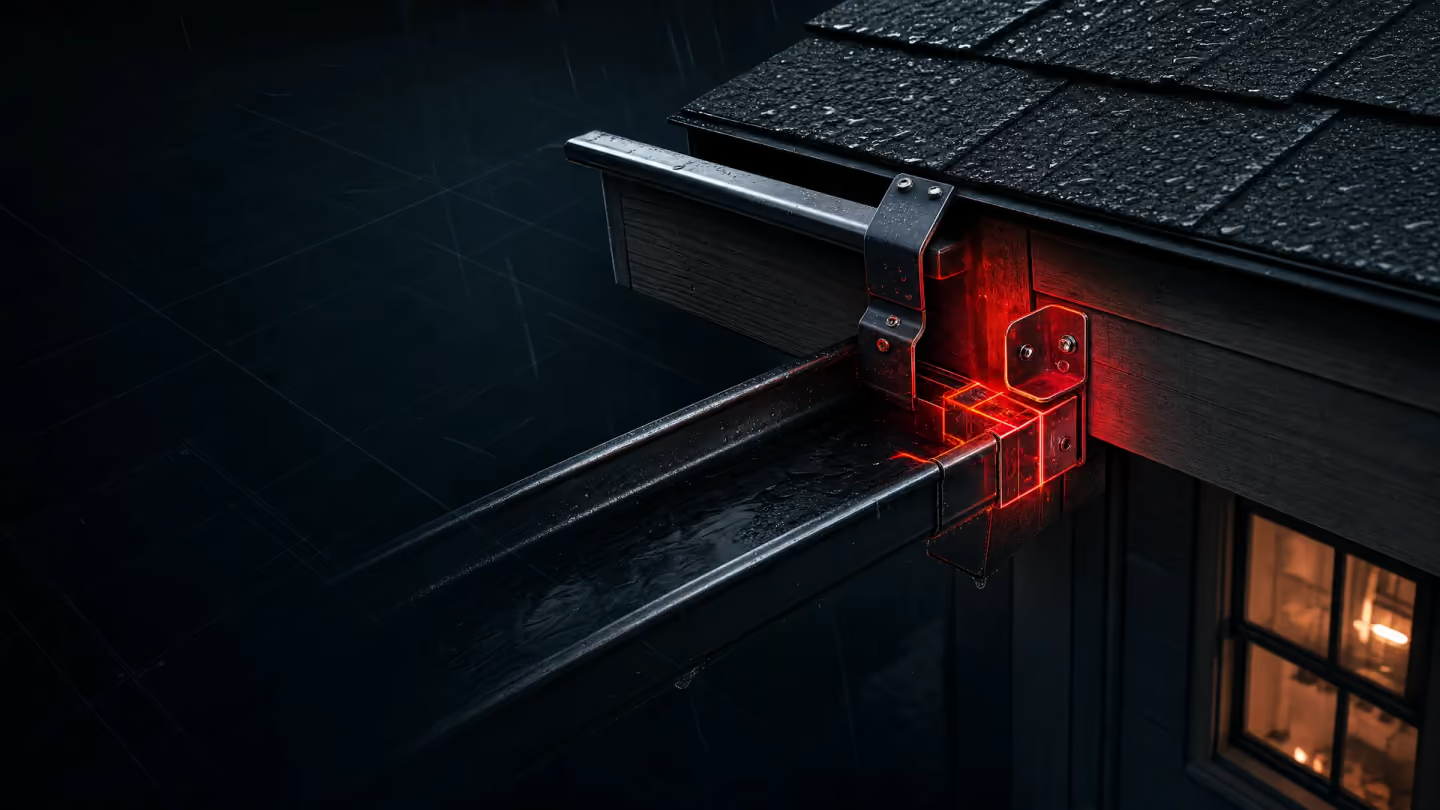
Detailed repair of a gutter joint and fascia connection during light rain at dusk

Gutter Repairs

Your master gutter repair pros.

Sagging runs, split seams, pinhole leaks, blocked downspouts, and bad pitch — diagnosed and repaired by the CMAC team.

  • Veteran-owned
  • Five-state service
  • Free inspection

Gutter Repairs, clearly scoped.

When searching for lasting gutter repairs, start with a documented diagnosis. The CMAC team identifies the failure before recommending a repair.

Most gutter failures are local. One hanger lets go, one seam splits, one outlet plugs, and the whole run starts behaving as though it needs replacement. Knowing the difference is the whole job, and it is what a free inspection is for.

01SCOPE MODULE

How gutters actually fail

Sagging from hanger failure or standing water

A gutter full of wet leaves is carrying real weight — water alone runs a bit over eight pounds per gallon, and a plugged trough holds gallons per foot. That load pulls fasteners out of soft fascia, and once one hanger goes the two beside it carry double and follow. The sag then creates a low spot that holds more water, which accelerates everything. Re-hanging with hidden hangers at tighter spacing usually solves it, provided the fascia behind is still sound.

Separated seams, corners, and end caps

Every joint in a gutter is sealed, not welded, and sealant is a consumable. Aluminum moves measurably with temperature swings, and across a Texas summer a long run cycles far enough to work a bead loose. Miters at inside corners are the worst offenders because they take concentrated flow from two planes. The repair is to cut out the old bead completely, clean the metal back to bright, and reseal with a gutter-grade sealant — smearing new sealant over failed sealant buys a season at most.

Pinhole corrosion and rust-through

On steel gutters, rust starts at cut edges, scratches, and anywhere debris holds moisture against the metal. It appears first as brown streaking on the outside face and then as a line of pinholes along the bottom of the trough. On aluminum, galvanic corrosion shows up where a dissimilar metal is in contact — a steel screw through aluminum, or copper flashing draining onto an aluminum gutter. A few isolated pinholes can be patched. A trough that is perforated along its length is done.

Downspout and outlet blockage

Blockages form at the transitions — at the outlet drop, at the upper elbow, and at the lower elbow above the discharge. A gutter that overflows only at one spot while the rest of the run stays dry is telling you the outlet below it is plugged, not that the gutter is undersized. Clearing and flushing confirms it in minutes.

Ice and freeze damage

The southern states get fewer freeze events than the north, but they get them, and a hard freeze on a full gutter does real damage. Water expands as it freezes, which splits seams and deforms end caps, and ice held in the trough adds weight in exactly the way that pulls hangers. Damage from a February freeze frequently is not noticed until the first spring rain overflows the run.

Fascia rot behind the gutter

This is the failure that turns a small repair into a real one. Water running behind the trough — because the gutter apron is missing, because the back lip sits too low relative to the shingle edge, or because the trough has overflowed for years — soaks the fascia board from behind. The board looks painted and fine from the ground while the back face is soft. Hanging new gutter on rotten fascia guarantees a callback, so the wood gets replaced first.

Improper pitch and standing water

If water sits in the trough a day after the rain stops, the run has lost its fall. That is either a settled hanger, a sag between hangers, or a system that was hung level to begin with. Correcting pitch to roughly a quarter inch per ten feet toward the outlet is often a matter of resetting a handful of hangers.

Impact damage

Ladders set against the front lip crush the profile and break the pitch. Falling limbs tear runs loose at the hanger line. Hail dents the trough face without necessarily compromising function, though it often accompanies roof damage worth documenting for a claim.

02SCOPE MODULE

Repair or replace

Repair is the right answer when the damage is confined to identifiable spots on an otherwise sound system: a few loose hangers, one or two failed miters, a plugged downspout, a section knocked loose by a limb, a pitch correction on one run. If the trough metal is straight, the finish is intact, and the fascia behind it is solid, repairing is cheaper and faster and will hold.

Replacement makes more sense when the problems are systemic rather than local. Watch for these:

  • Pinholes or rust perforation appearing in more than one run.
  • Sealant failing at most joints at once — a sign the whole system has aged out together.
  • Sectional gutter where nearly every lap is leaking.
  • A system that overflows in ordinary rain even when clean, which is a sizing problem no repair fixes.
  • Widespread hanger pull-out that traces back to fascia rot along the eave.
  • Cosmetic damage across the front elevation, where a patchwork of repairs will never look right.

What gutter repairs includes

Diagnosis first

We find why the run is failing before quoting a fix, because the symptom is rarely the cause.

Safer ladder work

The CMAC team handles the elevated inspection and repair work so the property owner does not have to.

Seams done properly

Old sealant is cut out and the metal cleaned before resealing, not layered over.

Fascia checked every time

We probe the wood behind the gutter, since rot there defeats any re-hang.

Honest repair-or-replace call

You get a straight answer on whether the system is worth repairing, in writing.

The CMAC process for gutter repairs

  1. 1

    Schedule

    Tell us what is happening at your property.

  2. 2

    Inspect

    We document the property and affected systems carefully.

  3. 3

    Plan

    Review a clear scope and written proposal.

  4. 4

    Build

    The CMAC team completes the approved work.

  5. 5

    Confirm

    A final walkthrough closes out the project.

Gutter Repairs questions

Why do gutters matter so much?

Gutters are the only thing moving roof runoff away from your foundation. When they fail, water sheets down the wall and saturates the soil at the footing, which is how you get foundation movement, wet crawlspaces, basement intrusion, and rotted fascia — all of which cost far more to fix than the gutters would have.

Do gutter guards actually work?

They reduce cleaning frequency substantially, but no guard is truly maintenance-free, and any company claiming otherwise is overselling. Different guard styles handle different debris: fine mesh handles pine needles and shingle grit that screens let through, while reverse-curve designs shed leaves well but can overshoot in heavy downpours. The right choice depends on what is actually falling on your roof.

What kind of company is CMAC?

CMAC Roofing and Sheet Metal LLC is a veteran-owned and operated construction and remodeling company founded by Christian Viveiros. We handle roofing, gutters, garage doors, restoration, and exterior work for residential, commercial, and multi-family properties. We are a GAF Master Elite® certified contractor and a GAF President’s Club award winner.

What states does CMAC serve?

Five: Texas, Oklahoma, Arkansas, Tennessee, and Georgia. CMAC publishes office addresses and local contact information for Dallas–Fort Worth (Haslet), Houston (Rosenberg), Austin (Georgetown), Oklahoma City, and Nashville. Arkansas and Georgia inquiries route through the regional line; no walk-in office is published in either state.

What are CMAC’s core principles?

Earn the customer’s trust, use only quality materials, and deliver exceptional workmanship. The company operates under the motto “Integrity Truly Matters,” and the practical version of that is simple: document what we find honestly, quote what the job actually requires, and stand behind the work after the crew leaves.

What does GAF Master Elite® mean?

GAF awards Master Elite® status to a small fraction of roofing contractors in North America. It requires proof of proper licensing, adequate insurance, and a sustained record of quality installations and customer satisfaction. Practically, it means CMAC can offer enhanced GAF system warranties that non-certified contractors cannot, and that GAF has independently vetted the company. CMAC is also a GAF President’s Club award winner.

Start with a free inspection.

Tell CMAC what is happening at the property. We will inspect the condition and put the recommended scope in writing.