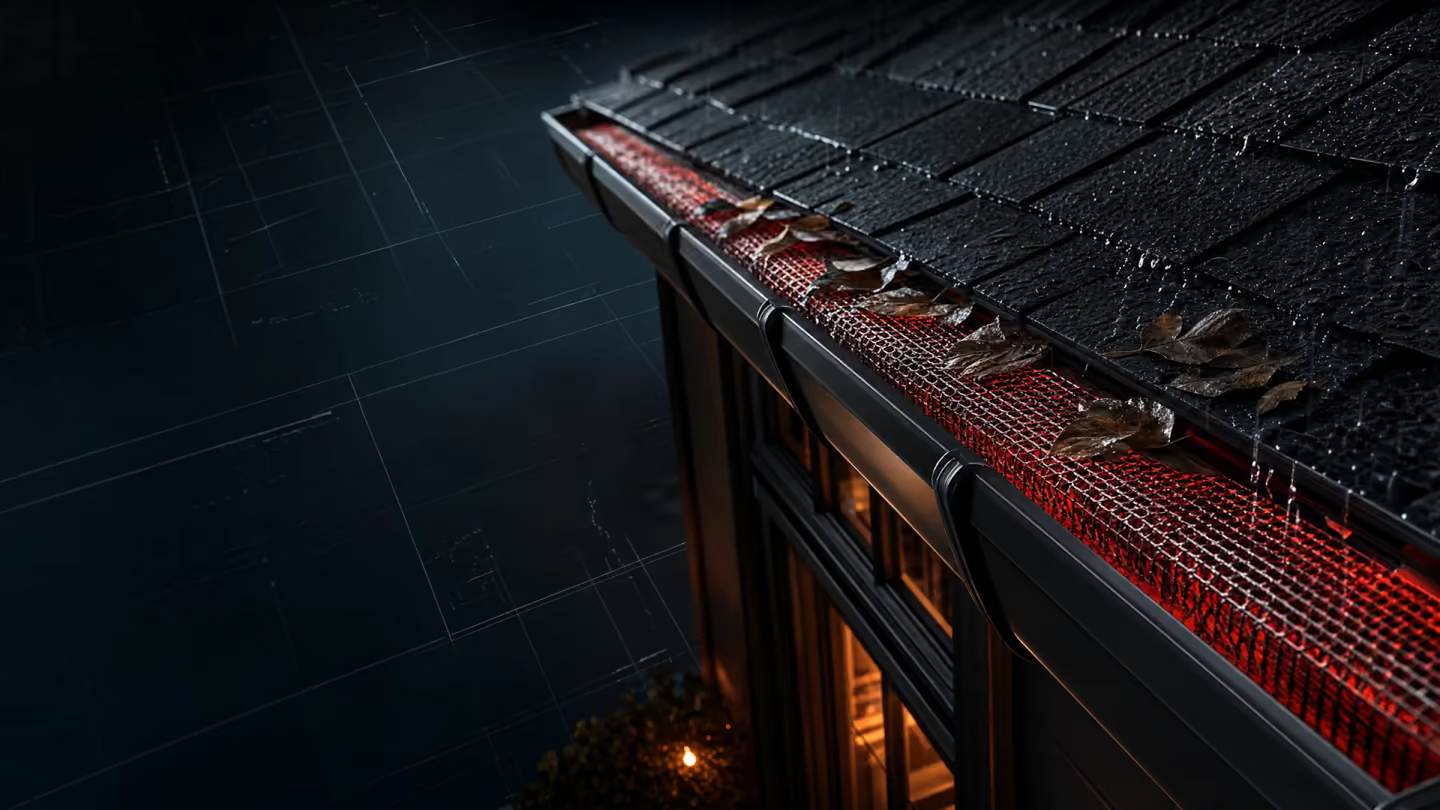
A close view of a precision gutter guard system shedding rain beneath architectural shingles

Gutter Guards

Get permanent protection with CMAC.

Gutter guard systems that keep debris out and let water in — plus an honest look at what each guard type does and does not handle.

  • Veteran-owned
  • Five-state service
  • Free inspection

Gutter Guards, clearly scoped.

Eliminate constant gutter cleaning with CMAC durable gutter guards. We ensure water flows freely while keeping all debris out.

Three problems push most owners toward guards. The first is the ladder. Cleaning gutters means standing on an extension ladder at the eave line, reaching sideways, with your hands full — a set of conditions that sends a lot of homeowners to the emergency room every year. The second is leaf blockage, which turns a working gutter into a planter and sends overflow down the wall. The third is ice: a trough packed with wet debris cannot drain, and what does not drain freezes.

01SCOPE MODULE

CMAC’s Gutter Guard systems

CMAC installs its own All-Season Gutter Guards, matched to the profile and outlet size of your existing or new gutter. A guard that does not fit the trough it is protecting is worse than no guard at all, which is why the guard conversation and the gutter conversation belong together.

02SCOPE MODULE

The four guard categories, honestly

There is no guard that ends all maintenance. Any manufacturer telling you otherwise is selling. What a good guard does is convert regular ladder work into occasional surface work, and that is a real improvement worth paying for. Here is what each category genuinely does well and where each one struggles.

Micro-mesh

A fine stainless or aluminum mesh, often on a rigid frame, laid over the trough. The openings are small enough to stop pine needles, seed pods, and most shingle grit, which is what separates micro-mesh from every cheaper option. It is the only category that reliably handles pine needles, and across East Texas, Arkansas, Georgia, and middle Tennessee that matters a great deal.

The tradeoff is surface tension and blinding. Very fine mesh can shed water in a hard downpour if the mesh has gone dirty, and a film of pollen, roof grit, or oak tassel can blind the surface until rain or a brush clears it. Quality varies widely by mesh gauge, frame rigidity, and how the guard is pitched, so installation detail matters more here than in any other category.

Perforated aluminum screen

A stamped aluminum panel with round or slotted holes. It is durable, it costs less than micro-mesh, it does not blind easily, and it handles heavy rain volume well because the open area is large. It stops leaves and twigs reliably.

It does not stop pine needles, which stand up in the perforations and eventually mat, and it passes shingle grit straight through to the trough. Under oaks or maples it is a strong, economical choice. Under pines it will disappoint you.

Reverse-curve and surface-tension

A solid nose that curves back over the front of the gutter, relying on water clinging to the curve and following it into a slot while debris carries past and falls off the edge. Well made and correctly pitched, it sheds leaves effectively and handles moderate rain.

The physics has limits. Surface tension is what makes it work, and in a high-intensity downpour water arriving with velocity off a steep roof can overshoot the nose entirely and skip the gutter. Fine debris and shingle grit ride into the slot with the water and accumulate inside, where you cannot see it, and cleaning generally means removing the guard. Many reverse-curve products also mount under the shingle course, which is worth understanding before it happens to a roof under warranty.

Brush and foam inserts

Brush guards are a long bottle-brush dropped into the trough; foam inserts are a wedge of open-cell material that fills it. Both are inexpensive, both install in an afternoon, and both keep large leaves from reaching the bottom of the gutter.

Neither keeps debris out of the gutter — they keep it on top of an insert that now sits inside the gutter. Fine material sifts in and packs around the bristles or into the foam cells, foam degrades under ultraviolet exposure, and both hold moisture against the trough, which accelerates corrosion on steel. They also become seed beds; finding grass growing out of a foam-filled gutter is common. Treat them as a temporary measure, not a system.

03SCOPE MODULE

What to weigh before choosing

  • What is actually falling on your roof — pines and needles rule out open screens entirely.
  • Rainfall intensity where you live, which is the honest limit on reverse-curve designs.
  • Roof pitch, since steep roofs deliver water fast and make overshoot more likely.
  • The age of the shingles, because grit shed is heaviest early and again late in a roof’s life.
  • Whether the guard mounts under the shingles, and what that means for your roof warranty.
  • Whether the gutter itself is sound, correctly pitched, and sized — no guard fixes any of that.

What gutter guards includes

Gets you off the ladder

Routine cleaning becomes occasional surface work instead of repeated trips to the eave.

Matched to your debris

Needle country and oak country call for different guards, and we specify accordingly.

Sized to your gutter

Guards are fitted to the trough profile and outlet so flow into the downspout is not choked.

Straight talk on limits

You get told what a guard will not do before it is installed, not after.

The CMAC process for gutter guards

  1. 1

    Schedule

    Tell us what is happening at your property.

  2. 2

    Inspect

    We document the property and affected systems carefully.

  3. 3

    Plan

    Review a clear scope and written proposal.

  4. 4

    Build

    The CMAC team completes the approved work.

  5. 5

    Confirm

    A final walkthrough closes out the project.

Gutter Guards questions

Do gutter guards actually work?

They reduce cleaning frequency substantially, but no guard is truly maintenance-free, and any company claiming otherwise is overselling. Different guard styles handle different debris: fine mesh handles pine needles and shingle grit that screens let through, while reverse-curve designs shed leaves well but can overshoot in heavy downpours. The right choice depends on what is actually falling on your roof.

Why do gutters matter so much?

Gutters are the only thing moving roof runoff away from your foundation. When they fail, water sheets down the wall and saturates the soil at the footing, which is how you get foundation movement, wet crawlspaces, basement intrusion, and rotted fascia — all of which cost far more to fix than the gutters would have.

What kind of company is CMAC?

CMAC Roofing and Sheet Metal LLC is a veteran-owned and operated construction and remodeling company founded by Christian Viveiros. We handle roofing, gutters, garage doors, restoration, and exterior work for residential, commercial, and multi-family properties. We are a GAF Master Elite® certified contractor and a GAF President’s Club award winner.

What states does CMAC serve?

Five: Texas, Oklahoma, Arkansas, Tennessee, and Georgia. CMAC publishes office addresses and local contact information for Dallas–Fort Worth (Haslet), Houston (Rosenberg), Austin (Georgetown), Oklahoma City, and Nashville. Arkansas and Georgia inquiries route through the regional line; no walk-in office is published in either state.

What are CMAC’s core principles?

Earn the customer’s trust, use only quality materials, and deliver exceptional workmanship. The company operates under the motto “Integrity Truly Matters,” and the practical version of that is simple: document what we find honestly, quote what the job actually requires, and stand behind the work after the crew leaves.

What does GAF Master Elite® mean?

GAF awards Master Elite® status to a small fraction of roofing contractors in North America. It requires proof of proper licensing, adequate insurance, and a sustained record of quality installations and customer satisfaction. Practically, it means CMAC can offer enhanced GAF system warranties that non-certified contractors cannot, and that GAF has independently vetted the company. CMAC is also a GAF President’s Club award winner.

Start with a free inspection.

Tell CMAC what is happening at the property. We will inspect the condition and put the recommended scope in writing.