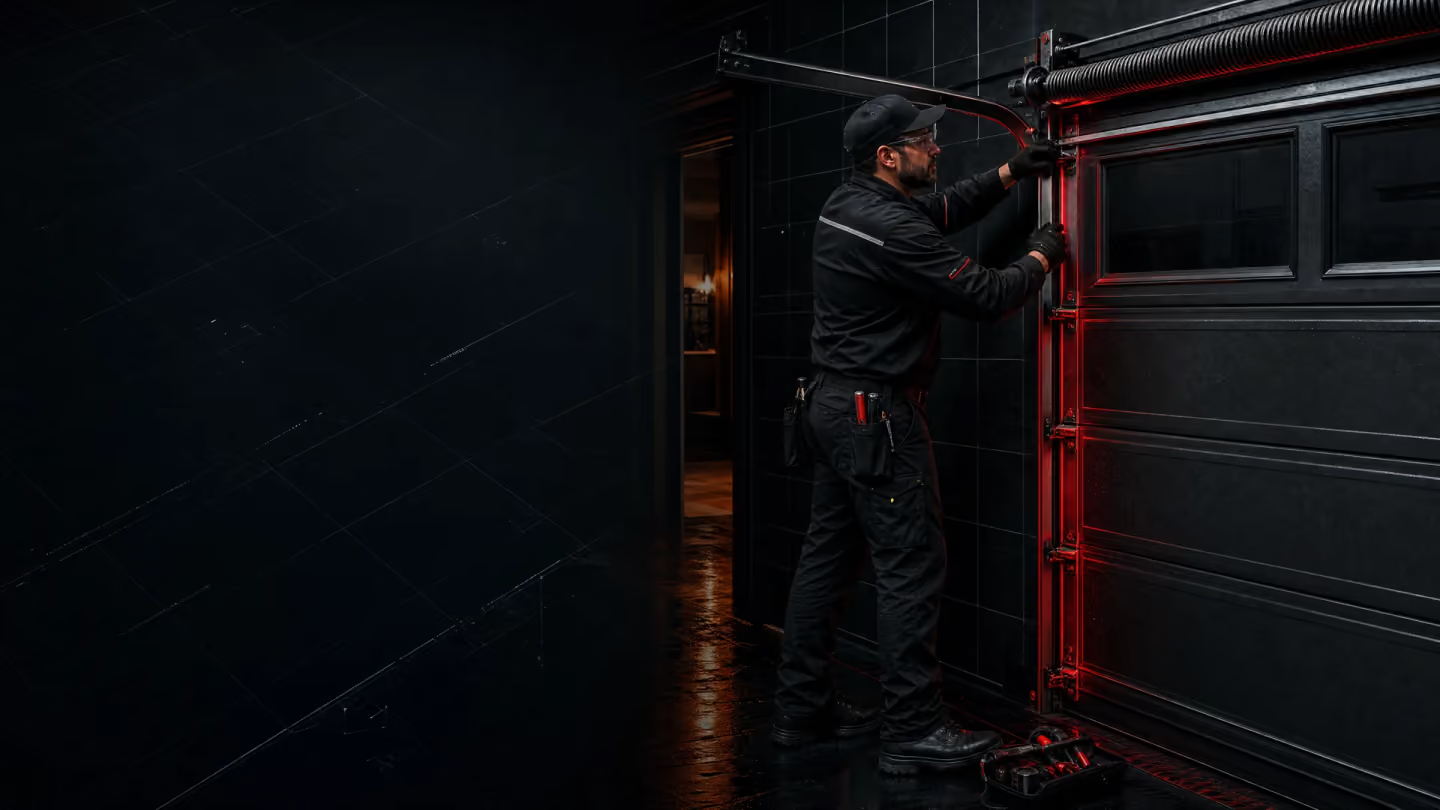
A garage door technician safely servicing rollers and track on a sectional door

Garage Door Repair

Your expert in garage door repair

Diagnostics, repair, and parts replacement — broken springs, cables, rollers, bent track, electrical troubleshooting, and off-track doors.

  • Veteran-owned
  • Five-state service
  • Free inspection

Garage Door Repair, clearly scoped.

CMAC provides expert diagnostics, repair, and parts replacement for homeowners, including broken springs, electrical and sensor troubleshooting, and off-track doors. Most repairs come down to one of a short list of failures, and knowing which one you are looking at tells you whether it is a service call or something more.

01SCOPE MODULE

Springs: the most common failure, and the most dangerous

Torsion springs mount on a shaft above the opening and wind up as the door lowers. Extension springs run along the horizontal tracks on either side and stretch as the door closes. Torsion is the more common modern arrangement, is more stable through travel, and generally lasts longer. Extension springs must have containment cables running through them so that a broken spring cannot become a projectile.

Springs fail more often than anything else on a door because they are the part doing the work. They are rated in cycles, and a standard spring rated around 10,000 cycles reaches the end of its design life in roughly seven years at four cycles a day, faster on a busy household. High-cycle springs cost more and last proportionally longer, which is usually the right call on a door that gets heavy use.

02SCOPE MODULE

Cables, drums, rollers, and bearings

Lift cables run from the bottom bracket to grooved drums on the torsion shaft. When a spring breaks, cables often slip off the drums or shred; when a cable frays or snaps first, the door drops on one side and jams in the track. Bottom brackets are under cable tension for the same reason springs are dangerous, and they get the same respect.

Rollers and their bearings are the quiet-versus-loud part of the equation. Worn steel rollers with sloppy bearings grind, chatter, and eventually let the roller stem work sideways out of the track. Nylon rollers on sealed bearings are quieter and a common upgrade during any repair that already has the door apart. Center bearings and end bearing plates on the torsion shaft also wear, and a squealing shaft under load is usually a bearing, not the spring.

03SCOPE MODULE

Bent track and off-track doors

A door comes off track after an impact, after a cable failure, or after being closed onto an obstruction. Once a roller is out, the door is unsupported on that side and the panel is taking load it was never meant to carry. Do not run the opener to “work it back in” — that bends track, tears hinges out of sections, and turns a repair into a replacement. Disconnect the opener and leave the door alone until it can be serviced.

04SCOPE MODULE

Electrical, sensors, and opener faults

The single most common “my door will not close” call is a misaligned or obstructed photo-eye. The safety system is doing exactly what it is designed to do: if the beam between the two sensors is broken, the opener refuses to close. A bumped bracket, a cobweb, a stored bin, direct sunlight into the receiver, or a nicked sensor wire will all produce the same symptom, usually with the opener light flashing a fault code.

The other frequent opener failure is a stripped drive gear. The motor runs and hums, the door does not move, and there is often a small pile of plastic shavings under the unit. On many openers a gear kit is a repair rather than a replacement — but if the door was out of balance, the gear will strip again unless the springs are corrected too.

Other electrical faults worth ruling out before replacing anything: a tripped GFCI or breaker, force and travel limits knocked out of adjustment, a stuck wall button, remotes that need reprogramming after a power event, and a lock mode accidentally engaged on the wall console.

05SCOPE MODULE

Sections and weather seal

Individual sections can often be replaced rather than the whole door, provided the model is still available — one more reason manufacturer choice matters years after installation. Bottom weather seal, or astragal, is a wear item that hardens and cracks over time and is the usual culprit behind water and debris under a closed door. Perimeter stop molding seals the sides and head.

Free, no-obligation inspections are available across Texas, Oklahoma, Arkansas, Tennessee, and Georgia. Call 1-888-389-CMAC.

What garage door repair includes

Springs

Torsion and extension spring replacement, including high-cycle upgrades.

Cables and drums

Frayed or slipped lift cables, drums, and bottom brackets brought back into balance.

Rollers and bearings

Worn rollers, center bearings, and end plates replaced to quiet the door.

Track and off-track doors

Bent track straightened or replaced and the door reseated safely.

Electrical and sensors

Photo-eye alignment, wiring faults, limits, force settings, and remote programming.

Diagnostics

A full balance and hardware check so the repair fixes the cause, not the symptom.

How CMAC handles garage door repair

  1. 1

    Balance and safety check

    The opener is disconnected and the door is lifted by hand to see whether the spring system is actually carrying the weight.

  2. 2

    Visual hardware inspection

    Springs, cables, drums, rollers, hinges, brackets, track, and the bottom seal are checked for wear, bends, and fatigue.

  3. 3

    Operator and electrical test

    Photo-eye alignment, reversal behavior, travel and force limits, wall control, remotes, and power are verified.

  4. 4

    Diagnosis and options

    You get the actual cause, what it takes to fix it, and an honest read on repair versus replacement.

  5. 5

    Repair and retest

    Parts are replaced, the door is rebalanced, and both reversal tests are run again before the technician leaves.

Garage Door Repair questions

Can I replace a garage door spring myself?

You should not. A torsion spring on a double door stores enough energy to cause severe injury or worse if it releases while being handled, and the winding process requires the correct bars and technique. This is the single most common source of serious DIY injury in residential maintenance. Call a technician.

My garage door will not close and reverses instead. What is wrong?

Nine times out of ten it is the photo-eye safety sensors near the floor — either misaligned, dirty, or with a blocked beam. Check that both indicator lights are steady and that nothing is in the path. If the lights are steady and it still reverses, the issue is more likely the down-force setting, an obstruction in the track, or a failing opener logic board.

Does CMAC offer emergency service?

Yes, for the situations that genuinely cannot wait: 24/7 emergency response for water mitigation, and 24/7 emergency garage door repair. Storm response work is dispatched as fast as conditions and crew availability allow after an event.

What kind of company is CMAC?

CMAC Roofing and Sheet Metal LLC is a veteran-owned and operated construction and remodeling company founded by Christian Viveiros. We handle roofing, gutters, garage doors, restoration, and exterior work for residential, commercial, and multi-family properties. We are a GAF Master Elite® certified contractor and a GAF President’s Club award winner.

What states does CMAC serve?

Five: Texas, Oklahoma, Arkansas, Tennessee, and Georgia. CMAC publishes office addresses and local contact information for Dallas–Fort Worth (Haslet), Houston (Rosenberg), Austin (Georgetown), Oklahoma City, and Nashville. Arkansas and Georgia inquiries route through the regional line; no walk-in office is published in either state.

What are CMAC’s core principles?

Earn the customer’s trust, use only quality materials, and deliver exceptional workmanship. The company operates under the motto “Integrity Truly Matters,” and the practical version of that is simple: document what we find honestly, quote what the job actually requires, and stand behind the work after the crew leaves.

Start with a free inspection.

Tell CMAC what is happening at the property. We will inspect the condition and put the recommended scope in writing.