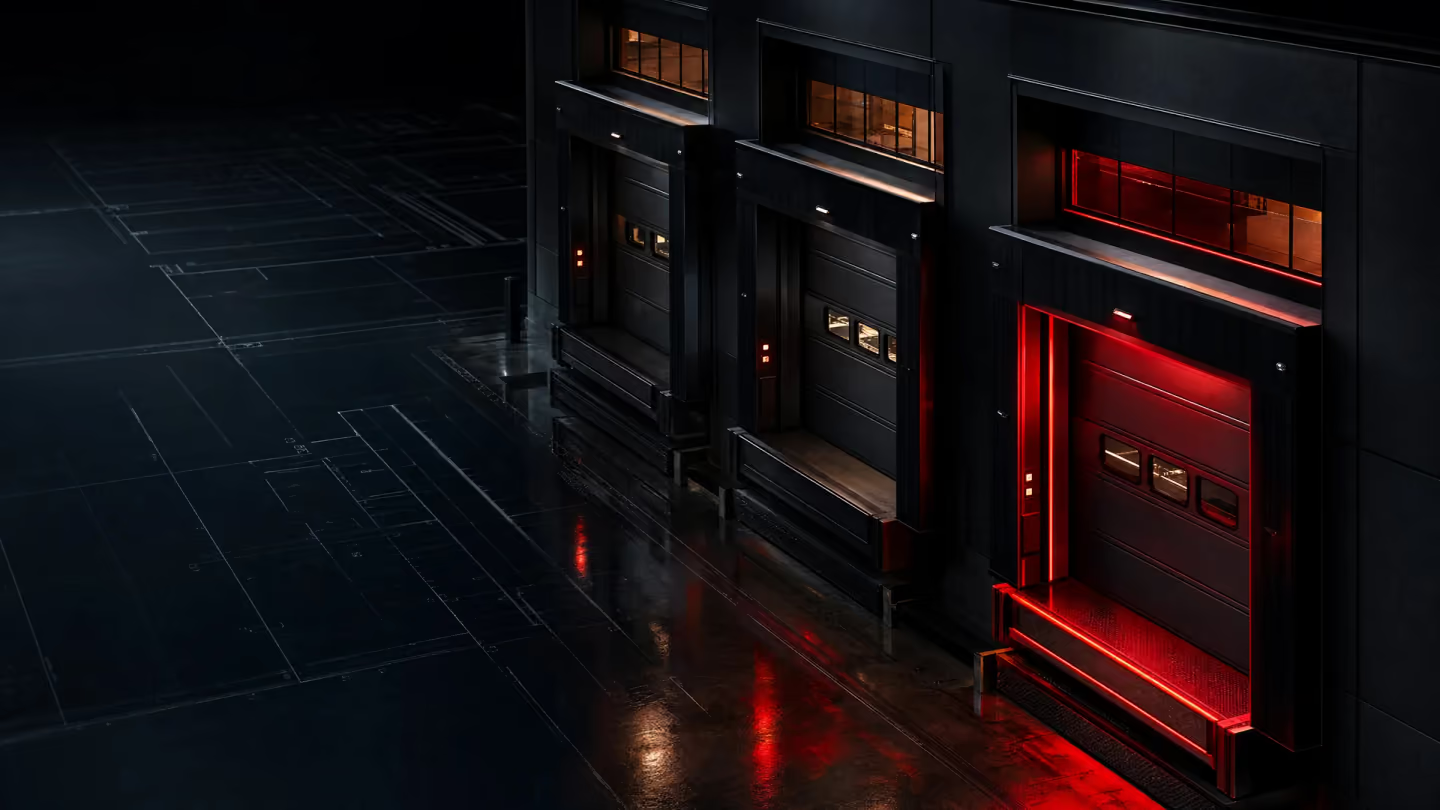
A modern commercial loading facility with durable sectional overhead doors at blue hour

Commercial Garage Doors

The commercial garage door experts

Installation, replacement, and repair for commercial and industrial properties — roll-up doors, dock doors, security gates, and insulated sectionals.

  • Veteran-owned
  • Five-state service
  • Free inspection

Commercial Garage Doors, clearly scoped.

CMAC installs, replaces, and repairs doors on commercial and industrial buildings: high-traffic roll-up doors, custom loading dock doors, specialized security gates, and heavy-duty insulated sectional doors. The division also handles door system upgrades, access control and automation, new construction installation, and insurance claim services.

A commercial door is a piece of operating equipment. When it stops, trucks stop, and the cost of the outage usually dwarfs the cost of the door. That changes how the specification should be approached: the question is not which door is cheapest to hang, but which door survives the duty cycle the building actually imposes on it.

01SCOPE MODULE

Cycle life is the specification that matters most

Springs and door systems are rated in cycles — one cycle is one full open and one full close. A door rated for 10,000 cycles sounds like a lot until you put it on a dock that runs 100 cycles a day. At that rate the rating is consumed in roughly three to four months of operation, and the failure will happen mid-shift with a trailer backed in.

Count the real traffic before selecting hardware. High-cycle spring packages, heavier bearings, and commercial operators cost more up front and are almost always cheaper over the life of the opening than repeated emergency service on an under-rated assembly. The same arithmetic applies to rollers, hinges, and the operator itself.

02SCOPE MODULE

Rolling steel versus sectional

Rolling steel doors are built from interlocking horizontal slats that coil onto a barrel above the opening. They consume almost no ceiling space, tolerate abuse, and suit tight openings, service bays, storage facilities, and anywhere sprinklers, piping, or low structure rule out horizontal track. Insulation options exist but are more limited than on sectionals.

Sectional doors run panels back along horizontal track under the ceiling. They insulate better, seal better, and accept windows, which is why they dominate on conditioned warehouses, distribution buildings, and anywhere the door is part of the thermal envelope. Heavy-duty insulated sectionals are the usual answer on cold storage and climate-sensitive space.

03SCOPE MODULE

High-lift and vertical-lift track

Standard track turns the door horizontal immediately, which eats overhead space. High-lift track carries the door further up the wall before it turns, freeing the area directly inside the opening for a lift, a conveyor, or racking. Vertical-lift track takes the door straight up the full height of the wall, which is what tall industrial bays and some dock configurations need. Both require adequate headroom and a structurally sound wall above the opening, so this gets verified on site before anything is ordered.

04SCOPE MODULE

Loading docks are a system, not a door

A dock opening is a door plus a leveler plus a seal or shelter plus bumpers, and each part protects the others. A worn dock seal lets conditioned air and weather in around the trailer. A failing leveler transfers shock into the door and the wall. Missing or crushed bumpers let a trailer strike the building itself. Servicing these together is how you stop the same door from being damaged repeatedly.

05SCOPE MODULE

Fire doors and life safety

Rolling fire doors are held open by a release mechanism designed to drop the door when heat or an alarm signal triggers it. Those assemblies are life-safety equipment, subject to inspection and drop-testing requirements, and they must never be blocked, chained, or obstructed by stored product. If a fire door has been painted over, propped, or shimmed, it has to be treated as a compliance problem and not a cosmetic one.

06SCOPE MODULE

Operators, photo-eyes, and safety edges

Commercial operators are selected by duty: standard duty for occasional use, medium and heavy duty for continuous cycling, with hoist chains for manual operation during a power failure. Entrapment protection is required on powered doors — photo-eyes across the opening, a monitored safety edge on the bottom bar, or both, depending on the door and the control type. Constant-pressure controls exist for exactly this reason and should never be defeated with a taped-down button.

CMAC serves commercial and multifamily property across Texas, Oklahoma, Arkansas, Tennessee, and Georgia, and handles insurance claim documentation and adjuster meetings when a door is damaged. Call 1-888-389-CMAC to schedule a free, no-obligation site inspection.

What commercial garage doors includes

Roll-up doors

Rolling steel for high-traffic openings where headroom is limited.

Loading dock doors

Dock openings specified with levelers, seals, and bumpers as one system.

Security gates

Specialized gates and grilles for storefronts, parking, and secured access.

Insulated sectionals

Heavy-duty insulated doors for conditioned warehouse and cold storage space.

Access control and automation

Operators, controls, and automation matched to the door’s real duty cycle.

Insurance claim services

Damage documentation and adjuster coordination on commercial losses.

The CMAC process for commercial garage doors

  1. 1

    Schedule

    Tell us what is happening at your property.

  2. 2

    Inspect

    We document the property and affected systems carefully.

  3. 3

    Plan

    Review a clear scope and written proposal.

  4. 4

    Build

    The CMAC team completes the approved work.

  5. 5

    Confirm

    A final walkthrough closes out the project.

Systems and manufacturers

  • Overhead DoorCommercial and industrial doors
  • ClopayResidential and commercial sectional doors
  • Wayne DaltonResidential and commercial doors
  • AmarrResidential and commercial doors

Commercial Garage Doors questions

Can I replace a garage door spring myself?

You should not. A torsion spring on a double door stores enough energy to cause severe injury or worse if it releases while being handled, and the winding process requires the correct bars and technique. This is the single most common source of serious DIY injury in residential maintenance. Call a technician.

My garage door will not close and reverses instead. What is wrong?

Nine times out of ten it is the photo-eye safety sensors near the floor — either misaligned, dirty, or with a blocked beam. Check that both indicator lights are steady and that nothing is in the path. If the lights are steady and it still reverses, the issue is more likely the down-force setting, an obstruction in the track, or a failing opener logic board.

Does CMAC offer emergency service?

Yes, for the situations that genuinely cannot wait: 24/7 emergency response for water mitigation, and 24/7 emergency garage door repair. Storm response work is dispatched as fast as conditions and crew availability allow after an event.

What kind of company is CMAC?

CMAC Roofing and Sheet Metal LLC is a veteran-owned and operated construction and remodeling company founded by Christian Viveiros. We handle roofing, gutters, garage doors, restoration, and exterior work for residential, commercial, and multi-family properties. We are a GAF Master Elite® certified contractor and a GAF President’s Club award winner.

What states does CMAC serve?

Five: Texas, Oklahoma, Arkansas, Tennessee, and Georgia. CMAC publishes office addresses and local contact information for Dallas–Fort Worth (Haslet), Houston (Rosenberg), Austin (Georgetown), Oklahoma City, and Nashville. Arkansas and Georgia inquiries route through the regional line; no walk-in office is published in either state.

What are CMAC’s core principles?

Earn the customer’s trust, use only quality materials, and deliver exceptional workmanship. The company operates under the motto “Integrity Truly Matters,” and the practical version of that is simple: document what we find honestly, quote what the job actually requires, and stand behind the work after the crew leaves.

Start with a free inspection.

Tell CMAC what is happening at the property. We will inspect the condition and put the recommended scope in writing.